Tree Removal in Lynn, MA
Dead, dying, leaning, or simply in the wrong place, removing a tree near a house is a job for an insured professional with the right equipment. We connect North Shore property owners with independent local tree services who can assess the tree and give you a written price.
Lynn homes at a glance
Source: U.S. Census Bureau, American Community Survey 2020–2024 5-year estimates, via Census Reporter.
What that means for tree removal in Lynn
Lynn is a city with dense neighborhoods and many street trees, so tree work here often means tight access, nearby houses, and trees close to the public way. About 63% of homes in Lynn were built before 1960, and the median home was built around 1946.
If the tree may be on the public way, the Lynn tree warden has to authorize any removal under state law, so check before anyone cuts.
About Lynn
Lynn is the largest community we cover, and nearly half of its homes were built before 1940.
The city also includes the large wooded park Lynn Woods, and coastal neighborhoods take the brunt of nor'easters.
Signs to watch for
- The tree is dead or has large dead limbs
- It leans toward the house, driveway, or wires
- Cracks, cavities, or fungus at the base or trunk
- Roots are lifting or the soil is heaving on one side
- An ash tree with thinning canopy or bark splits
What the work typically involves
- Assess the tree and site. The pro checks the tree's condition, what it could hit, access for equipment, and any wires nearby.
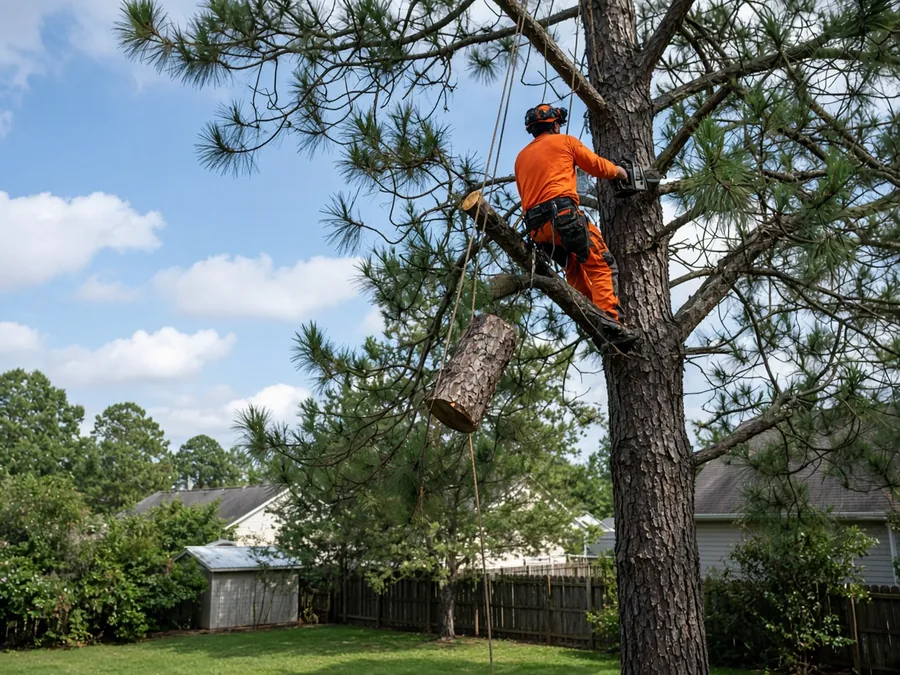
- Plan the takedown. Trees near structures are usually removed in sections with ropes or a crane rather than felled in one piece.
- Clean up. Ask whether chipping, hauling the wood, and raking are included.
- Stump. Stump grinding is often priced separately. Ask for it in writing.
Helpful resources: M.G.L. c.87 §3: public shade trees and the tree warden · Mass.gov: Emerald ash borer in Massachusetts
Why tree problems matter
Dead limbs, cracks, rot, and leaning trees can fail in a storm and damage homes, cars, and power lines. Emerald ash borer is also killing ash trees across Essex and Middlesex counties, and declining ash trees are a growing safety concern.
Sources: ISA TreesAreGood: Recognizing Tree Risk · Mass.gov: Emerald Ash Borer in Massachusetts · USDA APHIS: Emerald Ash Borer · USDA Forest Service: Massachusetts Forest Health Highlights 2025 · ISA TreesAreGood: Storm-Related Tree Damage
Tree Removal in Lynn: FAQ
Do I need permission to remove a tree in Lynn?
Usually not for a tree entirely on your own property, though you should check for local rules and for wetland areas, where the conservation commission may need to review work. Trees on the public way are public shade trees under state law, and only the Lynn tree warden can authorize removing or cutting them, usually after a public hearing. If you are not sure where the property line is, ask the tree warden or public works department first.
Can someone remove a tree near my Lynn house without damaging it?
Yes, that is routine for experienced crews. Trees near structures are taken down in sections, with limbs lowered on ropes or lifted out by crane. Ask how they plan to protect the house, lawn, and driveway.
What does tree removal cost?
It depends on the size of the tree, how close it is to buildings and wires, access for equipment, and what cleanup is included. Get a written quote. We do not set or guarantee prices.
Should I remove a dying ash tree?
Ash trees killed by emerald ash borer become brittle and can be more dangerous to take down the longer they stand. Have a professional look at it. The state asks that ash wood be chipped or left on site rather than moved.